
Need a New Year's Writing Reset? Meditate.

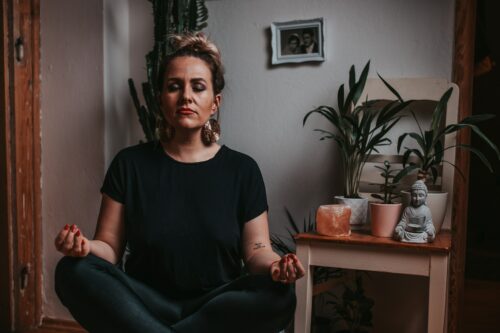
Photo by Jan Kopřiva on Unsplash
If you’ve resolved to take a more mindful approach to your writing business in 2026, meditating on a regular basis may be just the reset you’re looking for.
In this Q&A from the ASJA Confidential archives, ASJA member and former ASJA Confidential editor Sandra Gurvis talks to writer and long-time practitioner Amy Hertz, about the connection between meditation and crafting effective writing, regardless of your specialty or niche. Hertz is a 30-year student of Tibetan Buddhism, collaborative writer, has published several bestsellers, and previously held editorial and publishing positions at Penguin Random House, HarperCollins, Henry Holt, and Huffington Post, among others.
Hertz mentions the Headspace meditation app in the post; other popular apps include Insight Timer and Waking Up; read the New York Times Wirecutter review of those and other meditation apps here.
So far, meditation hasn’t worked for me. I end up thinking about grocery shopping, bills, and what I can snack on in the pantry.
That’s very common, as the mind is full of endless chatter. Which is why people just starting out should meditate for a very short period, maybe two minutes, maybe only 30 seconds or so to begin with.
With guided concentration meditation, you sit down and watch your breath–it is when you catch your mind wandering, and think oh, wait a minute, I need to go back to the breathing–that you allow the thoughts to pass and feel the space between the thoughts and some clarity. And when you can access mental clarity, writing becomes easier.
We fight for clarity so we can observe what’s coming up in the mind and allow it to express itself on the page. It can be accidental or it can be cultivated.
If we practice meditation, will it eliminate writer’s block?
I don’t believe in writer’s block; it’s more like thinker’s block. Instead of worrying about whether what you are doing is good or fits into a certain category, consider whether it’s authentic. When you work towards getting to a place of authenticity, the quality of writing goes up exponentially.
Also understand that 70 percent of what you initially write will probably end up in the garbage can. That’s just how it is. By recognizing this, it will become easier to turn off the internal censor and judgmental voice that can paralyze you. If you are afraid to throw things out you can never write anything. Meditation can help give you the distance and space to achieve the 30 percent of quality writing most of us are capable of and do so in an honest and brave manner.
How did you get into this field?
I first started meditating in 1989, in New York City. It was early in my publishing career when I became interested in Tibetan Buddhism. I was living in a dingy studio apartment at the time and in order to get started with meditation, I pulled a dining room chair into the tiny kitchen and set the timer on my microwave for two minutes.
I also had the great fortune to meet and learn from poet and longtime meditator Allen Ginsberg. We were studying with the same Tibetan lama, Gelek Rimpoche. Allen was using what he had learned from meditation as a writing path. He developed slogans that he used to teach writing.
But it wasn’t until seven or eight years ago that I felt that I had arrived at a point where meditation made a difference in my mind and my life. And I began to see how others could benefit from this as well, so I started working with authors, individuals, and corporations in using mindfulness to get their messaging right to make the best possible impact.
Any pointers and tips?
Like many things, it’s about practice. And also recognizing that you’re achieving a level of discipline by even attempting to mediate.
I recommend taking a look at the app Headspace, which helps get you started in small increments and provides daily reminders and tips. And don’t try to mediate for more than one minute at a time; you can build up your time gradually. The writings of Ginsberg and teaching of Tibetan Buddhism are also helpful.
When mediating, try to focus on your physical being—your butt in the chair, hands resting on your thighs, feet on the floor and the gravity supporting that. You can also concentrate on sensation and hearing. Don’t follow the reaction to the sounds, but just notice the sounds themselves.
**
Sandra Gurvis is the author of 18 commercially published books, including two novels. Her nonfiction titles include “Three Ringling Circus: A History of Sarasota, Florida and the Famous Ringling Brothers,” “Day Trips from Columbus, 4th ed.,” “Ohio Curiosities, 3rd ed. (in press)”; and “Careers for Nonconformists,” a Quality Paperback Book Club selection. A freelance writer for over 30 years, Gurvis has written hundreds of magazine and web articles, along with corporate profiles and technical articles for clients such as Ohio State University Wexner Medical Center, Ohio Health, Merrill Lynch, and the Council for Advancement and Support of Education (CASE). She lives in Sarasota/Bradenton, Florida, and is currently working on “Doing Hard Time in Geezerville,” a series of mystery/satires set in The Villages.