
ASJA Vice President Participates in Gathering Assembled to Protest Journalist Arrests
The recent arrests of independent journalists covering protests at a St. Paul, Minn., church, including Don Lemon, Georgia Fort, and Temple University student Jerome Richardson, who assisted Lemon, sparked a groundswell of outrage and concern among journalists and media allies.
It also sparked the rapid-fire development of a Feb. 2 town hall on press freedom hosted by the National Association of Black Journalists (NABJ). The two-hour virtual event, which NABJ held in partnership with the Black Star Network (BSN), featured representatives from ASJA and other press freedom organizations that raised their collective voice against media prosecution and in support of the First Amendment and journalists right to report.
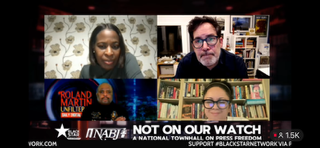
“I just want to acknowledge the risk that all of us are taking every day and speaking out,” said ASJA Vice President Gabrielle Gayagoy Gonzalez, who represented ASJA at the event.
ASJA is proud to collaborate with other organizations to support press freedom, Gonzalez said. “We’re here to serve as a bulwark against [the] chilling effects” of press persecution, she said. Gonzalez, who is a co-author of “Racial Justice at Work: Practical Solutions for Systemic Change,” and also teaches journalism and media literacy to public high school students, said there are things that journalists can do within their own communities to help support press freedom, including “mentoring, sponsoring up-and-coming journalists, and telling them about [available] scholarships and other resources.”
Press Freedom
More than 1,800 people tuned into a livestream of the event; to date, the YouTube recording of the meeting has been viewed more than 25,000 times.
The event built upon collective action of 40 press freedom organization, including ASJA, that issued a joint statement on Jan. 30 decrying the arrests of Lemon and Fort.
Hosts Errin Haines, NABJ president and an editor at large at The 19th, and Roland Martin, an NABJ vice president and owner of BSN, facilitated the discussion.
Other town hall panelists included Los Angeles Mayor Karen Bass, and representatives from the Committee to Protect Journalists (CPJ), Freedom of the Press Foundation (FPF), Institute for Nonprofit News, International Women’s Media Foundation (IWMF), National Press Club, Society of Professional Journalists, and The News Guild-Communications Workers of America (NGCWA).
Panelists shared views about the problematic aspects of arresting journalists, including how it erodes trusts, hinders the dissemination of information, cools journalists’ desire to report the news, and undermines democracy.
“The way the press is treated, it’s frequently an indicator of a healthy democracy. In the United States, the free press is imperiled and democratic norms are eroding,” said Katherine Jacobsen, CPJ program coordinator for the U.S., Canada, and Caribbean.
Not Here, Not Now
From the town hall, it’s clear that although press freedom is under attack, journalists are still committed to covering the news and building coalitions to keep the public informed.
Panelists agreed that when attacks on press freedom escalate and resemble adversarial methods employed in other countries, it’s time for journalists to band together and send one collective message of resistance.
“If you see journalists coming under attack, you know that there’s a broader crackdown that’s coming,” said Joel Simon, the founding director of the Journalism Protection Initiative at the Craig Newmark Graduate School of Journalism.
Layoffs, consolidations, and weakened labor protections in the media industry have made journalists more vulnerable to intimidation or retaliation, said John Schleuss, NGCWA president.
Safety First
Staying safe while reporting was another key concern. Panelists recommended using protective gear to prevent or minimize safety risks and develop a safety plan.
“We have this wild itch to go out in the world, find those stories, and then bring them back to the rest of the public,” Schleuss said. “We don’t typically have to think about safety, but more and more we do.”
“In the United States covering a protest is probably one of the most dangerous things a reporter can do now,” said Trevor Tim, FPF co-founder and executive director. The FPF’s U.S. Press Freedom Tracker tracks journalists arrests.
Haines, the NABJ president, noted that Black reporters “are disproportionately at risk for some of that danger” because they disproportionately cover protests, immigration and civil rights, among other issues
There is a growing awareness of risks to immigrants and women as well, said IWMF President Elisa Lees Muñoz. “It’s the first time that a person’s immigration status has been included in our analysis of risk of a journalist,” she said.
IWMF has conducted hostile environments training around the world for decades, and now offers a training program for journalists in the United States. Muñoz said it’s “truly heartbreaking that we’ve had to turn inward and focus most of our work in the United States.”
Town hall speakers cautioned journalists to guard their digital as well as their physical safety. Tools like the Committee to Project Journalists’ Digital Safety Kit are worth reviewing prior to covering protests, especially to project phones and equipment from searches and seizures, such as the search that happened to Washington Post reporter Hannah Natanson.
Money Matters
Speakers advised independent journalists to carry media liability insurance and have access to legal defense funds. Both Martin and Bass expressed the need for a collective legal defense fund that independent journalists could tap into. Other sources of available support:
- ASJA maintains the Writers Emergency Assistance Fund (WEAF), which provides emergency funds for independent writers,
- SPJ has a “modest legal defense fund,” Hendrie noted.
- Reporters Committee for Freedom of the Press maintains legal hotlines
- The National Press Photographers provides photographers with legal services and referrals to a trusted network of lawyers, according to NPP President Alex Garcia.
Muñoz encouraged independent journalists to take advantage of available resources, “because you need them to stay in the fight, and we need you to stay in the fight.”
**
ASJA board member and Diversity, Equity, Accessibility, and Inclusion Committee co-chair Lisa A. Crayton is a developmental book editor, collaborative writer (“ghostwriter’), and sensitivity reader for publishers and independent authors. A freelance writer, Crayton is the author of 21 nonfiction books, including 20 for children and teens.