
Revamping Your Freelance Writing Website for AI

In 2020, when I designed my writing website after a few years of full-time freelancing, my goals were simple: to let potential clients know that I existed and had writing and editing chops, and to be a home for my writing portfolio.
Six years later, that approach isn’t enough. In the age of AI, anyone can use a prompt to generate content in second on any topic. Our value as writers has to go beyond the words that we put on the page—to voice and point of view. I knew my website didn’t fully reflect that, and it had to.
I wasn’t alone in my feelings. Other ASJA members had reached the same conclusion. One is health journalist and content writer Rita Colorito. “My website was seriously outdated,” Colorito said. “Most of the links were no longer active or the client had removed my name (or) given credit to someone else. The design was also stale and less mobile friendly.”
Still, updating my website felt like a gargantuan task, one that required serious soul searching about who I was as a writer and what I could offer. I needed time to mull that over. Finally, this spring, inspiration struck. In this article, I’ll share the redesign process that I and two other ASJA members went through with the hope that sharing the details will benefit writers who want to update their own online presence in the AI era.
Writer Website Redesign Goals
Colorito and I each started by looking at how successful writers in the genres we write in approach their websites. I also checked out sites of creators such as Joe Lazer who’ve been vocal about human writers’ value in the age of AI.
Colorito’s goal for a redesign was to have a website that she could easily update, was mobile friendly, and housed her recent clips as PDFs “rather than links so I’d never have to worry about a link or article disappearing, or it linking to a piece where the client stripped my byline or added someone else’s.”
Better organization of clips was a goal for me, too. My old site’s portfolio had become a dumping ground for everything I’d ever written. I also wanted my site to feature the passion project work I’m now doing—writing novels.
ASJA member, journalist, and freelance writer Jaclyn Greenberg, who’s working with an agent to shop a book proposal, had a similar intention for her site redesign. “My goal was to have one place where potential publishers, editors, and readers could find my articles, read about my background, and reach out to me,” she said.
A Homepage That Emphasizes My Humanity
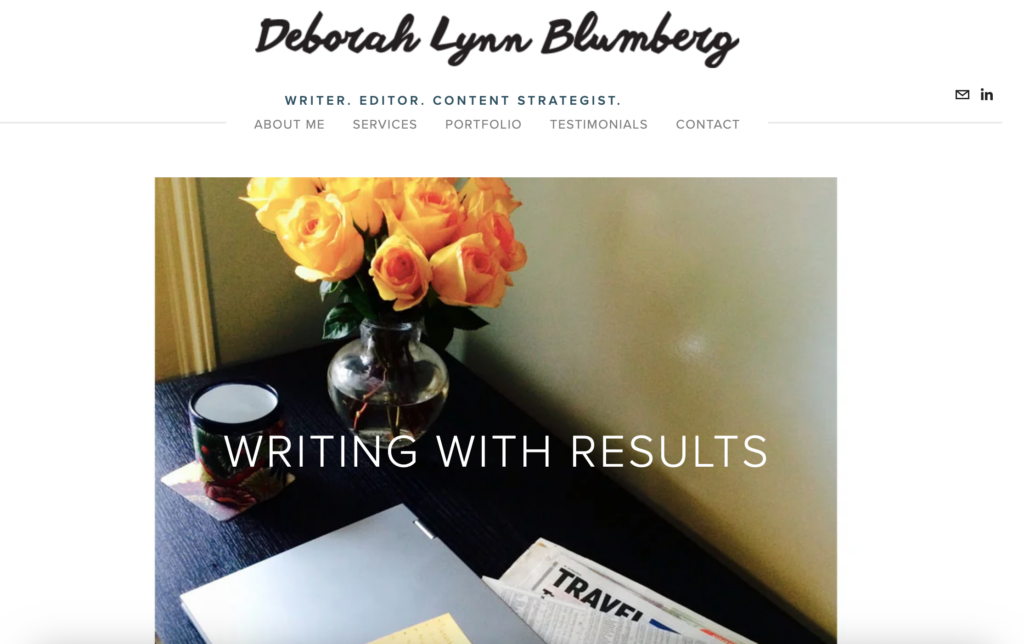
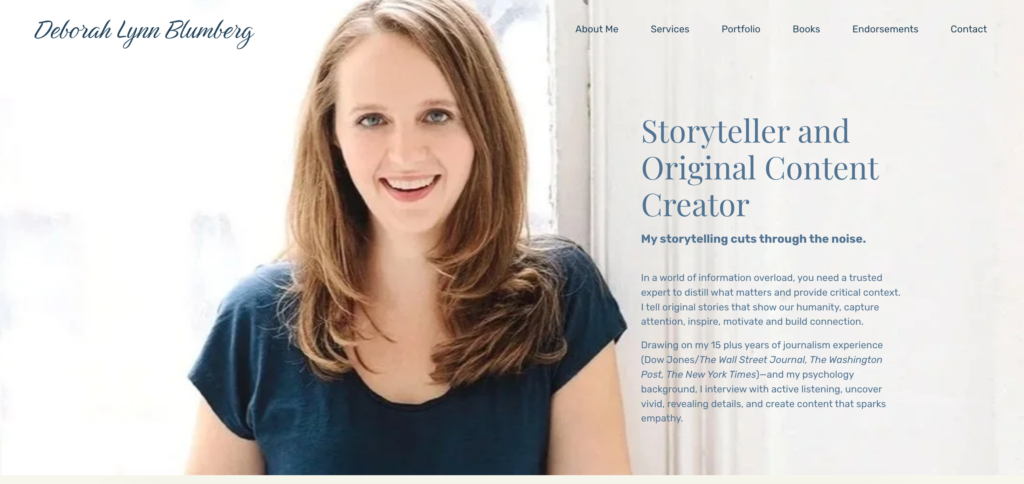
Deborah Blumberg’s old website (left) and updated design (right).
After my research phase, I went old school with pen and paper, sketching by hand what I wanted the main page of my website to look like. My old site’s homepage had a staged “writing image” of a laptop, newspaper, and rose I’d posed on my dresser. It was pretty, but didn’t tell or show people anything about me as a person. It had to go.
I wanted the new main image to be a photo of myself, along with few paragraphs about who I am and what I offer. I created a new section for featured projects on the main page, which includes “behind the scenes” sentences about what it was like to work on each project or what it meant to me.
I thought a lot about how I was going to refer to myself professionally. For now, I decided on “storyteller and content creator” rather than “writer and editor” to emphasize what I believe to be the importance of human storytelling in the age of AI.
I showed my sketch of the redesigned site to a few friends and my husband who gave great feedback, made some revisions, settled on subpages (including a new “Books” page), and organized my design ideas and text into a Word doc with a site map I could hand off to a designer.
Fine Tuning the Website Design
I was happy with the designer I’d used to create my original website on Squarespace, so at the end of May I hired her to work on the update.
Two weeks later, the designer sent me a draft website. It looked great overall. I liked how she organized my portfolio page by type of content and used drop-down menus. Separately, I created a Google doc of my clips organized by client, which I linked to on the new site so clients can easily search my clips by keyword.
Over the next few weeks, we went through a few rounds of edits, with the site getting closer to my vision for it. I ended up working with a second designer I found through Squarespace’s marketplace on final edits I felt strongly about, like eliminating empty space throughout the site to make it look more polished, making the main image on my Books page an interesting shape, and optimizing all of my pages for mobile. The Squarespace marketplace lets designers from around the world bid on projects, so you can find someone you match best with personality and price-wise. The designer I chose, Jen, is talented, responsive, creative, and I highly recommend her.
My redesigned site launched in late June and I posted a link to it on LinkedIn. I was happily surprised to see that, based on analytics, the post reached 1,336 members. I asked for feedback, and a few people shared broken links and ideas to make my portfolio more user-friendly.
Lessons Learned from Website Updates
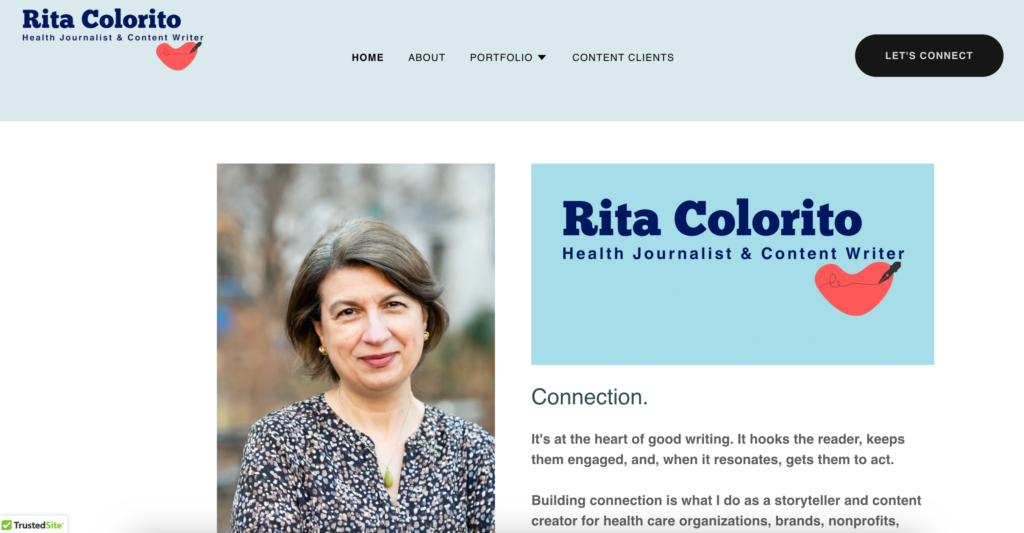
During her website redesign, Colorito spent eight to 10 hours a day for five days downloading and converting her previously published articles to PDFs. “It was tedious,” she said. “If you can afford to hire someone, it is worth it.”
She suggests doing a soft launch of an updated website on ASJA’s Facebook page to work out any kinks. If you’re designing the site on your own, she also recommends choosing a color scheme that matches the type of work you do or speaks to your personality.
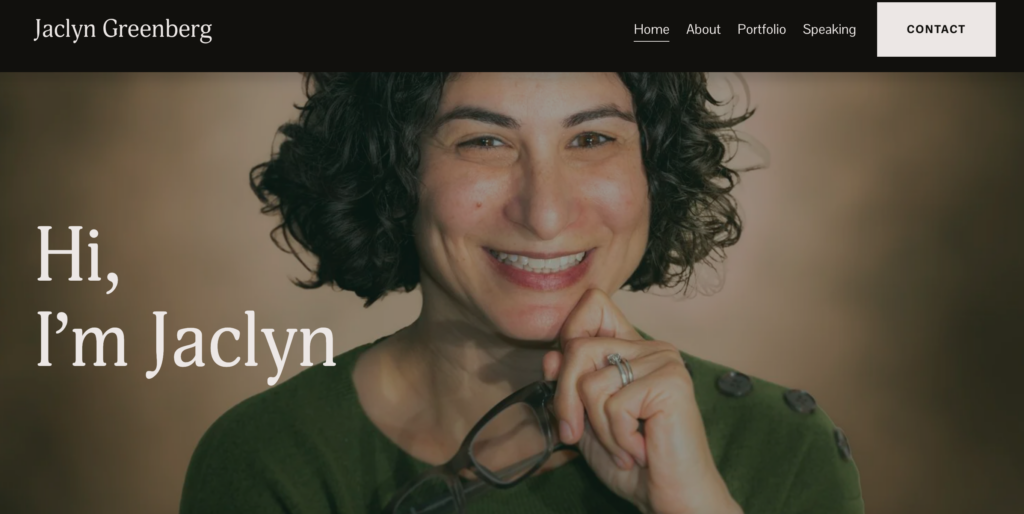
Greenberg hired a website designer who she found in a freelance-related group online. If you’re hiring someone to do the work, she suggests finding a designer who “really digs into your work to understand you and what you want to showcase,” she said. “My designer became a friend because she read my work and helped me figure out how to present myself well. She genuinely cared, and that made all the difference. I absolutely love my new website and think it was completely worth the time and money.”
I feel exactly the same way. In the end, the $700-ish I spent on my redesign was completely worth it. I feel more confident in how I’m presenting myself to the world as a freelancer in the age of AI.
**
Deborah Lynn Blumberg is a freelance writer and content marketer specializing in business and finance and health and wellness. She got her start at Dow Jones/The Wall Street Journal, reporting on financial markets during the height of the credit crisis. Clients and publications include: The New York Times, The Washington Post, The Houston Chronicle, J.P. Morgan, Mastercard, The U.S. Chamber of Commerce, Stanford University, MIT, AAA, and the American Heart Association. She’s the president of ASJA’s Washington D.C.-area chapter. She’s working on her first book about how her great grandparents helped to save a group of refugees from the Holocaust alongside a world leader. She’s also building a collection of memorabilia from Gertz. the New York City department store her family used to own. Find her at deborahlynnblumberg.com.