
A Journalist’s Guide to Thriving in the Era of Influencers and AI

This article was written by one of the dozen independent journalists who received scholarships to the 2026 ASJA conference.
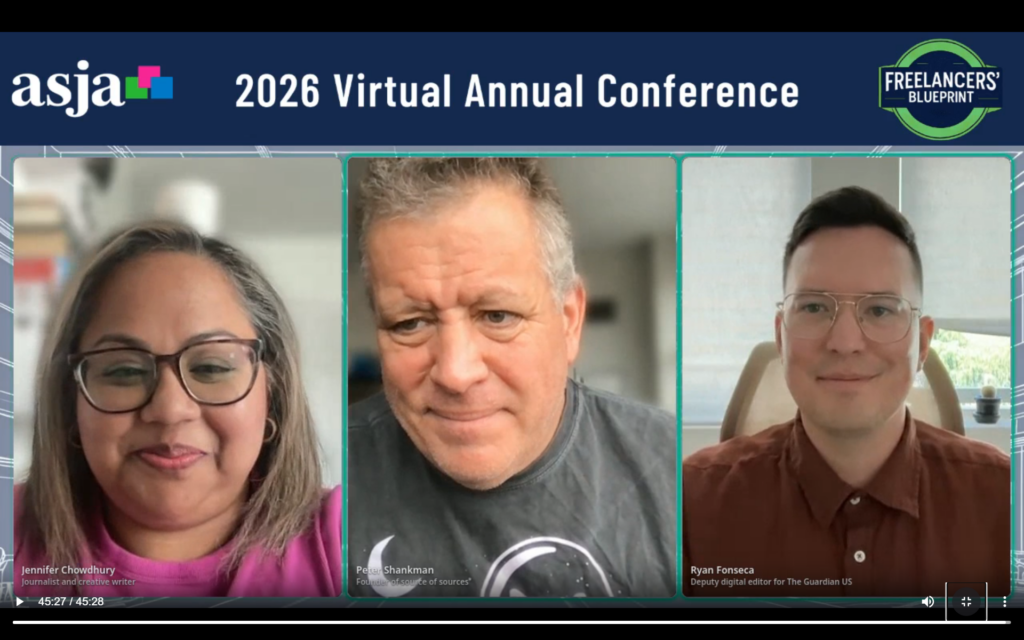
The rise of AI and social media influencers have fueled fears about the future of journalism, but industry experts speaking at the 2026 ASJA virtual conference pushed back against this narrative, offering guidance on how reporters can adapt and thrive in an increasingly digital world.
Although concerns about AI continue to grow, journalism is not a dying profession, but one that must evolve with changing technology, according to the speakers at the “A Journalist’s Toolkit” session.
In the “Age of the Influencer” Journalists Need to Adapt
If everyone has the same tools or same publishing platforms, it can be hard to determine who is a journalist and who is not, especially for the average reader scanning on social media, said Ryan Fonseca, deputy editor for The Guardian US.
Journalist and creative writer Jennifer Chowdhury says this is due to the “age of the influencer,” where influencers have adopted a journalist’s role of sharing information—regardless of its factuality.
According to the session speakers, journalism has changed in a sense that journalists are no longer competing only with other news outlets, but with the infinite stream of algorithm-driven content on social media feeds.
It has become more difficult for journalists to appeal to audiences because people no longer actively seek news as often as they once did, but instead encounter it while scrolling, Fonseca said.
Reading news was more of a “ritualistic practice,” whether in a newspaper or intentionally searching for an article. “Today it’s the social media habit and the news is sometimes in there, but it’s mixed in with animal videos and AI slops to keep people’s attention,” Fonesca said.
To overcome this, journalists need to adapt to technological advancements instead of restricting themselves to traditional journalistic standards that, in some cases, no longer resonate with modern audiences, Chowdhury said.
“We’re stuck in the traditional model, sourcing everything and making sure we have enough characters in our story,” she said. “We have an advantage here, but we do have to learn how to speak or write to audiences in a different way.”
How Journalists Can Use AI
Use AI to your advantage, said Peter Shankman, founder of Source of Sources, a service journalists can use to find sources.
Journalists can use AI to improve your life professionally or personally without relying on it as a crutch, Shankman said. But it cannot replace your knowledge and skills.
“AI is not going to make you an incredible writer overnight,” he said. “If you’re a terrible writer or communicator…AI will allow you to be terrible at those things at a scale.”
Shankman encouraged attendees to always expand their knowledge on what is happening in the world of journalism and technology. He advised them to spend at least 30 minutes a day reading or checking out newsletters to stay up to date with what is happening in the world. “Those who keep learning will be adept for future jobs,” he added.
Read more coverage of the 2026 ASJA virtual conference here. Individual recordings of conference sessions will be available for purchase in July—to find out more, subscribe to the ASJA Weekly or visit ASJA.org.
**
Elissa Odeh is a Palestinian immigrant journalist based in the Greater Philadelphia area who covers communities shaped by conflict, displacement, and immigration, amplifying voices often reduced to headlines. She is a 2026 ASJA conference scholarship winner aspiring to use journalism to fight injustice around the world. See more and reach her through her LinkedIn profile.