
How Journalists and Writers Are Making AI Work - But Not Write - for Them

This article was written by one of the dozen independent journalists who received scholarships to the 2026 ASJA conference.
I am — dare I say it — an AI skeptic.
So far, every pitch I’ve heard about AI’s usefulness has boiled down to “it can write for you.” As someone who loves the art and craft of writing, this has left me unconvinced.
Against this backdrop, the 2026 ASJA virtual conference was a refreshing change. It was the first time I’ve heard from other professional writers on how they use AI. And conference speakers did not disappoint. Below are some highlights that speakers shared about how AI can be useful to those who love to write.
AI for Transcription
In all of the conference’s ubiquitous talk of AI, using it for transcribing was all but assumed given how much time it saves. As speaker Kirk Miller, InsideHook senior lifestyle editor, said AI transcription “has changed my life.”
AI transcription tools mentioned by speakers and attendees included:
- Otter.ai, which several speakers called a “gamechanger” or “lifechanging”
- Mira’s AI-powered glasses, which transcribe conversations in real time
- Whisper Flow, an AI voice keyboard for iOS
- WhisperScript by Waverly
AI as a Personal Assistant…
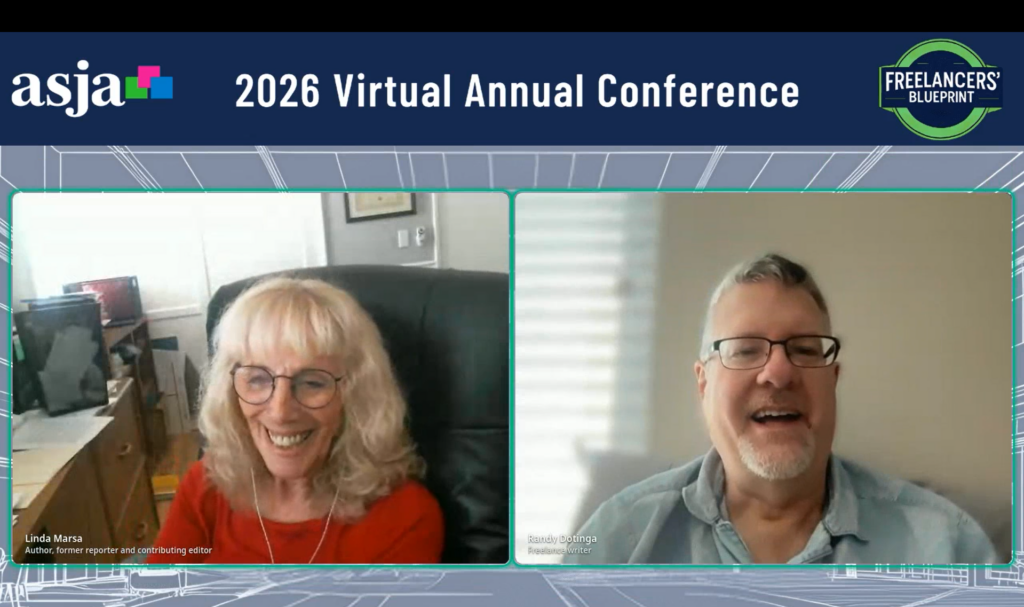
“We all know that there’s so much grunt work that we do that really isn’t related to actual journalism,” said Linda Marsa, author of the book “The Cure for Everything” and a former New York Times reporter. According to Marsa, AI agents can easily do some of this non-writing drudgery, such as compiling prior coverage round-ups or translating industry-specific jargon ahead of interviews.
Other speakers cited AI as a valuable assistant for the business side of their freelancing work. Some specific examples included:
- Using Beautiful.ai for creating slide decks for webinars or presentations
- Integrating Claude with other tools (email, CRM, etc.) to automate update processes
- Using the Monarch app or HoneyBook AI for financial management and invoicing
…Or as an Editorial Assistant
Whether participants used the phrase “editorial assistant” or not, many reported using AI to help with the tasks that bookend actual writing. They recommended everything from generating ideas and questions on the one end, to proofreading and making cut recommendations on the other.
Randy Dotinga, freelance writer and past president of ASJA, shared a list of things that journalists can ethically use AI for that encapsulates those editorial assistant-type tasks. They include:
- Brainstorming story ideas or generating a story outline
- Coming up with a list of potential sources, especially to help diversify a source pool
- Creating images from data
AI as a Tool for Writers with ADHD
Though few speakers named attention-deficit/hyperactivity disorder directly, many speakers talked about challenges common to writers (like me) with ADHD. These include having difficulty getting started, being easily distracted, loathing and avoiding repetitive tasks, and time management problems, to name a few. AI can be a tool to help with these challenges.
Speaker Peter Shankman, past founder of HARO and current founder of Source of Sources, has ADHD, and said he uses AI to reduce repetition in his day. Specifically, he integrates Claude with a variety of apps to regulate his schedule, up to and including turning on his lights in the morning to simulate dawn and get him ready for a workout.
“My lighting in my apartment comes up at 4 a.m. so I’m on the bike and I get the dopamine and all that.”
Speakers shared additional uses for AI that address ADHD-related challenges, including:
- Using transcription services or other AI tools to summarize conversations, emails, meeting notes, etc. to help get you the information you need to act faster.
- Drafting repetitive communications like pitch emails, interview requests, post-interview thank you notes, FOIA requests, query letters, etc.
- Tackling highly repetitive formatting tasks like creating large reference lists or writing end notes according to specified citation styles.
Using AI to Kickstart Your Writing
The “blank page problem” is a subset of the ADHD-coded challenges AI can help solve.
“I don’t know about you guys, but the thing that I find hardest to do is just getting started,” Marsa said. “And that’s what [AI] does beautifully; it gets you started.”
Shankman has much the same experience. If he sits down to a blank page he can easily get distracted, he said. But it’s a different situation if there’s something already there.
“If I have the first paragraph in front of me, I’m going to write,” he said. “Being able to allow it to start me is great.”
Tips for Working With or Around AI
In addition to speakers and participants’ hands-on examples of how they use AI, the conference included considerable talk about working as a freelance writer in the AI era. Some specific tips included:
- Have pre-2022 work in your portfolio. Older work shows you were writing successfully in the beforetimes.
- Avoid describing or thinking of yourself as just “a writer.” In the age of AI, anyone can be “a writer.” Instead, describe yourself — both to yourself and your clients — in terms of what makes you unique and human. For example, highlight your beat specialties or your personal identities.
- Make sure you are visible in your work. This can be literal, like putting your photo on your portfolio site and making sure you have an “About Me” description. Or it can be more esoteric, like developing your voice so it is identifiable even when AI uses your content as an answer to a reader’s question.
- Optimize your writing for AI. To do this, build on your SEO skills. Take special care to avoid large blocks of content, use header tag hierarchy, and make your text highly scannable. Use heads, subheads, and section headers to pose the sorts of questions potential readers might ask an AI, then use your content to answer those questions.
The most often echoed tip people shared was also the least tangible: Change how you think about AI and adapt.
Almost every speaker had their own version of this advice. My favorite came from Corinne McKay, a career-long freelance French/English translator. She said there is no way to “AI-proof” a writing career in the age of AI, but offered: “The work hasn’t disappeared, it’s just changed shape.”
Attendees can access the full 2026 virtual conference on Airmeet through May 30. Beginning Monday, May 11, anyone can buy access to the full conference replays–ASJA members and nonmembers–for $149. Conference content is available through May 30, giving people three weeks to enjoy every keynote, session, speaker handout, and session chat. Watch for full details coming soon. In addition, recordings of individual conference sessions will be available for purchase in July.
**
Kerry Halladay is a trans journalist who has spent most of their career as a staff reporter and editor for agricultural news outlets, writing most recently for Farm Journal. They were an ASJA conference scholarship winner and are exploring the world of freelancing. Kerry also loves the em dash and refuses to relinquish it to the slopheap.