
Help Your Book Break Through to Reach Agents, Libraries, and Curators

This article was written by one of the dozen independent journalists who received scholarships to the 2026 ASJA conference.
By Leigh Morrison
Authors are committed to telling their stories, but when it comes to getting others on board—including key stakeholders like agents and booksellers—the formula for breaking through can feel elusive.
The 2026 ASJA virtual conference offered three days of wisdom for aspiring authors across its books track, providing welcome insights in the form of sessions and panels, in addition to the popular virtual book pitch slam.
Replays of all books sessions as well as sessions on journalism and content writing, three keynotes and other conference events are available on the Airmeet platform for anyone who attended through May 30. Starting May 11, replays of the full conference are available to the general public for $149, and will also be accessible through May 30. Get more information and buy the replays here.
Honing the Perfect Nonfiction Pitch
Robin Colucci, founder of World Changing Books, author of “How to Write a Book That Sells YOU,” and an ASJA board member, kicked off the conference books track with a session titled, “Honing the Perfect Nonfiction Pitch in Three Sentences.”
Colucci encouraged writers to home in on how their book is unique in the marketplace before pitching. To do that, she challenged attendees to consider how to complete a “declaration of uniqueness” structured in the format:
“My book will be the first book ever to ___ so the reader can ___.”
“If you can’t complete this clearly and compellingly, spend some more time refining your concept,” she said.
When working on a book idea, Colucci encouraged attendees to reflect on what it could mean for the future:
- How do you want to be known? Would you be excited to lead this conversation for at least the next 5 years?
- How will this book advance your business or career?
- Who will read this?
For the latter, she argued that the audience should not be “everyone,” which is too broad to land with agents. Instead, she asked writers to consider what your ideal reader already knows that they want and how your book would address it.
Next, Colucci suggested a practical exercise: find five books published in the last three years in which you can identify similar relevance, as well as what your book would add to the conversation.
When pitching, she encouraged writers to use a three-sentence structure that should take no more than 60 seconds to convey:
- Lead with a hook, something timely and relevant to grab an agent’s attention within the first 15 seconds. Don’t lead with your biography, a common misstep that can cause busy agents to tune out.
- After the hook, explain why you are the person to write this book. Touch upon your credentials and the authority you bring to the topic.
- Share a clear value proposition, identifying what readers would gain from your book.
After the prepared pitch, she advises simply asking, “Would you like to see the proposal?”
Colucci cautioned that memoir is a difficult genre to sell, particularly a memoir pitch without clear social relevance. She suggested that reframing a memoir as a crossover genre could help cut through mountains of aspiring memoirist noise landing on agents’ desks–advice echoed by several agents at the live book pitch slam.
Expert Tips for Getting Your Book into Libraries and Book Stores
In a session titled, The Other Side of the Bookshelf: How Do Physical Bookstores and Libraries Decide What to Stock? moderated by ASJA board member KJ Bannan, attendees heard from professionals working in education, corporate, and the public sector who manage book collections.
- Stephanie Anderson of BookOps manages the team that selects material for the New York Public Library
- Shannon DeVito is senior director of book strategy at Barnes & Noble
- Paula Mae Carns is head of the Literatures and Languages Library at the University of Illinois Urbana-Champaign.
The panelists’ different perspectives illustrate how various stakeholders evaluate and select books for curated collections.
According to Anderson, libraries use assessment criteria to develop their collections, including book reviews, patron requests, budget, and alignment with other books, including “known collection gaps,” where they determine if theyneed more or fewer books that are similar. Libraries often seek out self-published books, but encounter challenges (acquiring?) e-books due to formatting issues and limitations on payment methods available to them, Anderson said.
DeVito, the Barnes & Noble executive, said the company generally doesn’t seek out self-published books—a valuable consideration for writers considering different publication methods, depending on audience and reach goals. Booksellers, often within specific stores, are the decisionmakers when it comes to which books to buy, and how many, she said. This can vary significantly from store to store and across markets. Like Colucci, DeVito encourages writers to visit stores and libraries to see what is on display. Other considerations that booksellers care about or prioritize:
- Covers
- Books on current events or trends
- Early relationships, which can make a big difference in scaling reach, because someone who loves a book will support in getting it on other people’s radar.
Carns, the University of Illinois librarian, said student and faculty requests significantly shape library collections. Authors can make an impact by writing to them directly. Both Carns and Anderson encouraged writers to make reach outs personal: “Here’s who I am and what I can offer you,” rather than a generic, “I’d love you to see my book.” Once a library accepts a book from an author, the institution is likely to purchase books they publish in the future, Carns said.
Other suggestions for getting noticed the panelists shared:
- Attend American Library Association Forums, author talks, or online programs.
- Visit stores in person and talk to booksellers.
- If you have a publicist, make sure they understand your positioning and goals for you book so they are prepared to advocate for you.
- Ask your publisher if they have anyone who specializes in library marketing.
Virtual Book Pitch Slam: Putting Pitches to the Test
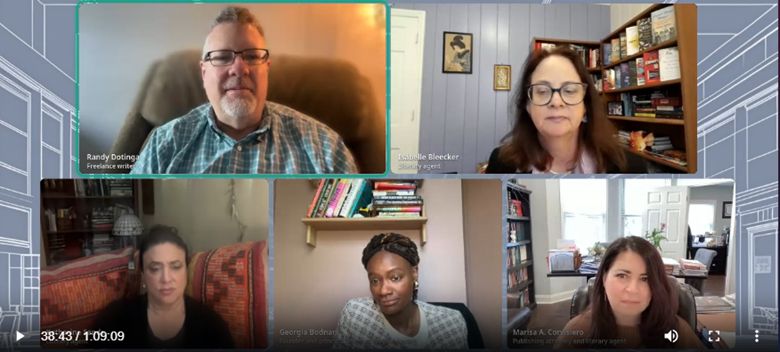
All of this wisdom prepared conference attendees for the book pitch slam, where select participants shared pitches for a book live for a panel of agents (and the audience) and received real-time feedback. Pitches included ideas for books on immigration history, navigating college transitions, grief, family wisdom and trauma, and organ transplants. Some insights from feedback to pitches:
- History books always have an audience; frame stories around individuals for a human-level view.
- Be thoughtful about proposed book structure, which can make or break a pitch.
- Memoir is the most-pitched genre; success often comes down to quality of the writing. Memoir can feel more marketable when framed prescriptively (“what lessons should we take from this story?”)
- Unique stories tied to larger narratives are more likely to break through.
- Connections to science can strengthen proposals, where applicable. Investigative books are popular.
- When pitching children’s books, avoid using too many words; read children’s books to get a feel for different age groups.
Agents’ preferences for pitches differ. All who spoke at the conference like to get a strong query as an email, with no attachments. Writers pitching fiction should include the first 10 pages. For fiction, agents also typically require a book proposal, and expect writers to submit materials through a query manager, unless they ask to get it via email.
Agents were intrigued by the pitches that conference goers shared, offering structure and framing suggestions specific to each concept, and authors left with expert guidance catered to their genres, goals, and intended audience, making it evident why pitch slams are a consistent draw across ASJA events. Learn more about upcoming pitch slams and how you can get involved here.
Attendees can access the full 2026 virtual conference on Airmeet through May 30. Beginning Monday, May 11, anyone can buy access to the full conference replays–ASJA members and nonmembers–for $149. Conference content is available through May 30, giving people three weeks to enjoy every keynote, session, speaker handout, and session chat. Watch for full details coming soon. In addition, recordings of individual conference sessions will be available for purchase in July.
**
Leigh Morrison is a writer and educator who uses humor and humanizing storytelling to advance social change. She is a contributor to “Racial Justice at Work: Practical Solutions for Systemic Change” (2023) and has been featured in various publications including TulipWolf Journal and The Wellesley Review.