
The Art of Co-Working Online

I’ve never had a better workspace than the New York City subway. The rumbling ride somehow let me get out of my own way. Laptop out, I could start a draft in Flatbush and finish it in Midtown. The same draft would have taken hours of pained sighs and flopping around back in my 10 x 10-foot room. Part of the secret, I think, was the subway’s combination of familiarity and novelty.
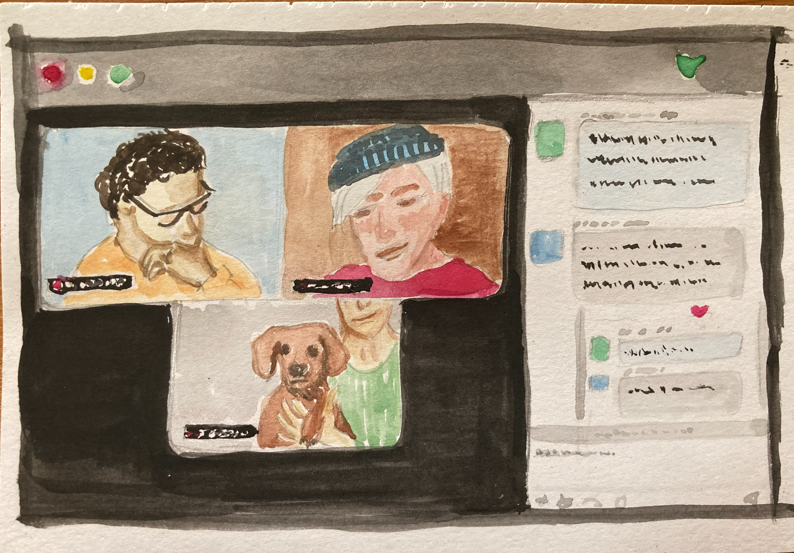
The next best workspace is a virtual co-working session. On a mostly muted Zoom call, other solo workers and I often accomplish much more than we would have working on our own. Sure, online gatherings can wear on you, but they can also offer company and courage and humor. They add newness to sameness. And boy howdy, can they be good places to get stuff done.
So I like ASJA’s two weekly accountability sessions, which meet at noon Eastern time on Mondays and Thursdays. Both are on Zoom; check the ASJA members-only Facebook page or contact the organizer (Jennifer Billock and Emily Paulsen, respectively) on the day of the session for a link.
Why Does Co-Working Work?
Co-working is sometimes called body doubling, a phrase that makes me picture two hippies entwined on a beach towel. Terminology aside, whether you and others are sharing a real desk or a virtual room, there’s something reassuring about their quiet presence while you’re trying to accomplish something.
Friendly faces can dislodge mental blocks. Anxiety recedes. Your brain finally gives permission to get down to business. And, as with scheduling a morning jog with a buddy, there can be accountability, too: If folks are expecting you, it’s just easier to show up in the first place.
Find Your People
My favorite co-working sessions are the ones I share with other writers—like ASJA’s—and with work-from-home friends.
I also meet with a personal co-working group via my paid Zoom account. Using an email list, I tell co-workers when I’ll be in each day and share the link; people join as they’re able. If I need to leave a session and go do something in real life, I designate someone to co-host if they want to keep working and let in newcomers.
Sometimes, no one shows up. But knowing someone might can still bump me out of inertia. I’ve heard the same from a co-worker I once inadvertently left in the virtual waiting room for a while. She was able to focus on her work based purely on the likelihood of company.
Another fine place where co-workers gather is the website Focusmate, which offers three free one-hour sessions per week; unlimited sessions cost $8 a month in a one-year subscription. You can schedule sessions ahead of time if you like. Get up early and you might work with someone from Europe or the Middle East; night owls might meet folks in Asia. It’s a neat glimpse into the lives of others, with the occasional conversation—though the heaviest users are all business, keeping interactions polite but brief.
I’ve also joined privately organized co-working sessions where users share pomodoro-style methods (timed sprints and breaks) to do everything from homework to housework to karate on-screen.
The Art of the Co-Working Session Chat
Talking aloud during a session can be distracting; unmute is for occasional greetings or making a request of a co-host. But the chat—the window of text that appears next to the video window—adds zest. There people can trade dopamine snacks when attention flickers, typing in a strange-but-true fact, ways to strengthen a pitch, a wisecrack. At its best, the chat becomes a collaborative comedic art form.
But at baseline, it’s a comforting reminder that the world is many-splendored, comprising not only one’s own dull desk and task, but also dachshund-shaped purses, Noah Wyle, and Ronald Reagan’s astrologer. (You had to be there.)
The other day, I used the chat to share the secret to looking 36 on Zoom when you are well past that: Video>Adjust background & effects>Video>Touch up my appearance. Another co-worker told us about ALCS.co.uk, which helps writers collect royalties. And so on.
In the chat, you can list the task you particularly don’t want to do (viz., sighs and flopping). Break it into steps; announce each step’s completion. The replies help, even emoji or generic sentiments like “You got this!,” especially coming from colleagues grappling with their own hairballs.
The chat is also a fine place to practice another minor art form: selecting an interesting emoji—or one so orthogonal to the point that its very absurdity perfects the exchange. Recently, for instance, I reacted with a shrimp emoji to someone’s announcement that they’d completed their outline. Why not? Surely shrimp, too, complete tasks in their own way.
**
Jenny Blair, MD, MS, is a Vermont journalist, science writer, and editor with particular interests in nature, agriculture and agroforestry, medicine, and disabled communities. Find her LinkedIn profile here. If you’d like to join her co-working group, use the “Send a Message” button at the end of her ASJA member profile.
Browse Articles
Topic
Productivity, Running Your Business, Tips, Freelance Life