
This article was written by one of the dozen independent journalists who received scholarships to the 2026 ASJA Conference.
Let’s have a moment of silence for the letter of introduction.
That is exactly what Julie Sturgeon, owner of the Freelance Success community (FLX) and executive editor of Thule Mystery, asked attendees to do at the 2026 ASJA virtual conference session, “Finding Clients: Lead Generation That Gets Results.” And she meant it.
“It served us well,” Sturgeon said. “But we need to move on with our lives and go make a living.”
The LOI, long the freelance journalist’s handshake with editors and content strategy managers, is not getting you rejected in 2026. It is getting you buried. Editors and creative directors are drowning in inboxes full of writers with similar backgrounds. The problem is not your credentials. It is that your LOI is making them do the mental work.
“They’re stressed. They’re triaging fires,” Sturgeon said. “They don’t have the bandwidth to brainstorm an assignment for you.”
From ‘Here I Am’ to ‘Here’s What I Fix’
Sturgeon and co-presenter Liam Carnahan, writer, content strategist, and FLX co-host, made the case that freelancers need to shift from sending LOIs to sending potential clients a concrete offer. This mirrors a broader conversation that ASJA has been tracking about how AI is reshaping independent writers’ work, including how we find and pitch clients in the first place.
According to Sturgeon, a strong offer has three parts: a clear problem, a defined service, and a measurable win. She gave an example of an offer aimed at a publishing client: “I specialize in diagnosing why professionally written mystery manuscripts underperform at Amazon. Let’s fix the right problems before they become expensive ones. My packages start as affordable as $100.”
That kind of language tells an editor or content strategy director? exactly what you will do, why it matters to them, and what it will cost. It removes the burden of imagining how to use you.
“When you take the lead in determining your role with your target, you’re going to have a steadier income and a lot fewer of those panic months,” Sturgeon said.
For freelancers who feel stuck identifying what problems they solve, Sturgeon had a practical suggestion: ask an AI tool. She described feeding a simple prompt into ChatGPT: “You are a development editor. You would like to work with Thule Publishing on a freelance basis. What are some of the situations or problems you could offer to solve that would get the publisher’s attention?” The responses, she said, generated more ideas than she could use.
Your Digital Presence Is Being Searched Right Now
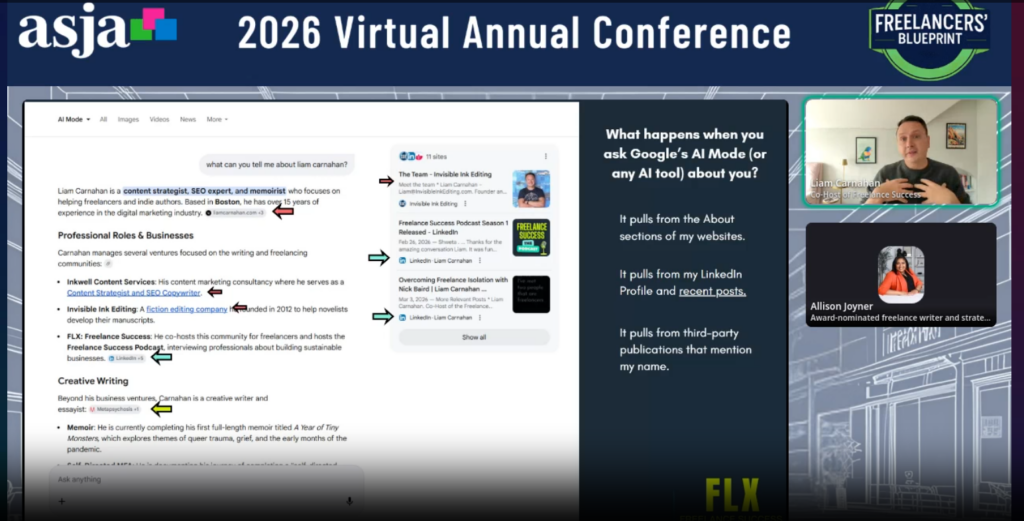
Once you land in an editor or client’s inbox, the first thing they do is Google you, so make sure what people find reflects who you are and what you do, Carnehan said.
“You are responsible for your own digital presence and how you appear in search,” he said. “If you don’t have control over how you show up, you’re going to have a really hard time standing out.”
He recommends doing a quick audit: type your name into an AI tool and read what it surfaces. The results pull from your website’s “About” page, your activity on LinkedIn, and third-party mentions. All of those are things you can shape.
A personal website remains the strongest foundation of your online presence. “Nothing gives you more control than a website that you built, that you have the keys to,” Carnahan said.
For LinkedIn, he pushed back on the idea that constant posting drives results. His recommendation: spend one hour a week focused entirely on direct connections. Find people you want in your network, comment on their posts, and send a DM with something genuine to say. Mass outreach, he said, is a waste of time. Personal outreach is not.
Sturgeon illustrated the point by sharing about the most effective LinkedIn outreach she ever received. It started with someone asking how she felt about Indiana University’s national championship in football. Nothing to do with work. Everything to do with treating her like a person.
“When we got down to business, it was a lot more enjoyable,” she said.
The Takeaway: Be Human
Both speakers agreed that the most effective lead generation strategy is also the most human.
“Be genuine. Be kind,” Carnahan said. “That speaks to my values, and it takes a lot of the intimidation away.”
The LOI is not gone. The skills behind it, including clear writing, targeted research, and understanding what an editor needs, still matter. They just need to be packaged differently. Less resume. More offers. Less cold. More connected.
Nobody said freelancing was easy, Sturgeon reminded the room. “But nobody said it had to be miserable either.”
**
Tasmiha Khan is the co-founder of Lighthouse Media Consulting, and has bylines in The New York Times, TIME, and National Geographic, among others. She was a 2026 ASJA conference scholarship recipient. See her LinkedIn profile here or learn more at TasmihaKhan.com
Browse Articles
Topic
Marketing, Pitching, Running Your Business, Content Marketing