
As AI applications for writing and writing adjacent activities become more widespread, prominent writers and writer groups are working together to come up with best practices that acknowledge the benefits those tools can offer and the risks they represent.
Last week, a coalition of leading media industry practitioners led by Working Group on AI Guidelines for Ghostwriting published guidelines that specifically address using AI for ghostwriting and other forms of collaborative writing work. The group was created by New York agency Gotham Ghostwriters and includes several ASJA members.
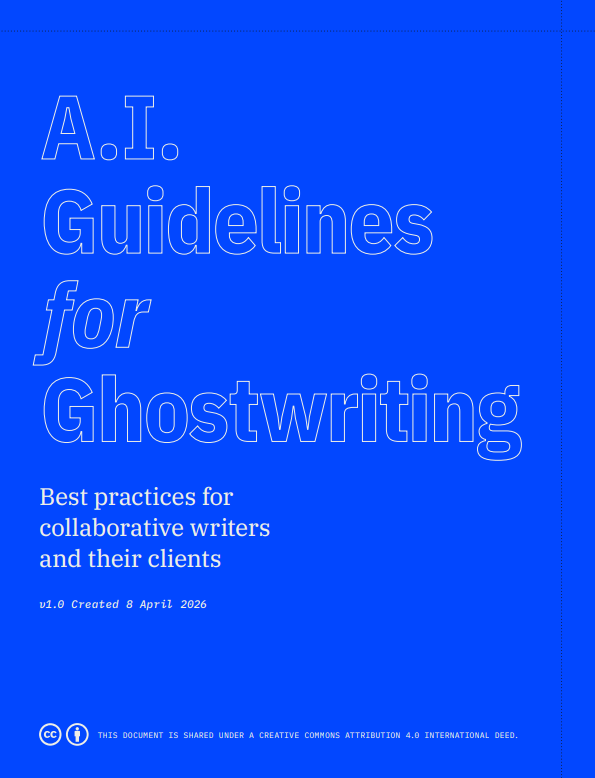
The document, “AI Guidelines for Ghostwriting,” is intended to “to establish a common baseline for the industry.” It is free and available for use under a Creative Commons license. See the full document here.
“Having guidelines for using AI is a positive development,” said ASJA President Darcy Lewis. “We still have much to learn about AI’s effects on the industry, and many writers still have mixed feelings about it. But this is a step in the right direction because it spells out best practices for using it and how to communicate how you use it with clients.”
AI Guidelines Goals, Audience, and Statement of Principles
The goals for the document are to provide guidance for professional writers adapting to the challenges that AI and large language models (LLMs) represent and to guide how writers and their clients communicate about how they use AI.
The document includes the following sections:
- A statement of principles. An example principle: “Writing is a fundamentally human activity. Its goal is to communicate meaning from writers to readers.”
- Recommended disclosures. The guidelines include three levels of disclosures that writers, including book ghostwriters, should make to their clients or publishers about how they use AI, reasoning that to do so “creates mutual understanding, which benefits everyone in the publishing ecosystem.” The first tier covers utilitarian applications, including using AI for transcription, spell checking, citations, and other admin-level tasks. The second tier covers research and analysis, and a third tier covers generative uses, such as using AI to generate titles, draft outlines, or write text.
- Information for understanding and managing AI risks. The document spells out risks related to using AI so both writers and their clients are prepared to address the challenges, including risks related to copyright, training, plagiarism, factual error, and risk of false quotation.
- Client responsibilities
- Using the document
- Disclaimers
How Writers Can Use the AI Guidelines for Ghostwriting
The guidelines are intended for writers or editors who work for hire on books or other content and the clients or authors they work with. However, some sections could apply to independent nonfiction writers working in other genres. According to a Mediabistro article about the guidelines, the document can serve as a contract conversation starter to negotiate what AI uses would or would not be acceptable for a given project, noting “That kind of documented clarity protects everyone.”
The Working Group on AI Guidelines ad hoc working group of writers was convened by Gotham Ghostwriters, and includes ASJA member and former ASJA Vice President Lisa Rabasca Roepe, and ASJA member and Association of Ghostwriters founder Marcia Layton Turner. ASJA board members Robin Colucci and Michelle Rafter were among another group of writers who provided feedback on the guidelines before they were published.
Writers, agencies, and publishers can adopt and share the guidelines provided they use the document verbatim and acknowledge the source: “AI Guidelines for Ghostwriting.” Writers can modify it for their own use, but must link to the original source and explain how it was modified.
Read additional information here and see Gotham Ghostwriters’ press release about the guidelines here.