
Meet the Member: Tasmiha Khan on Battling Stereotypes, Being Fearless, and Gaps in Coverage of Islamic Cultures
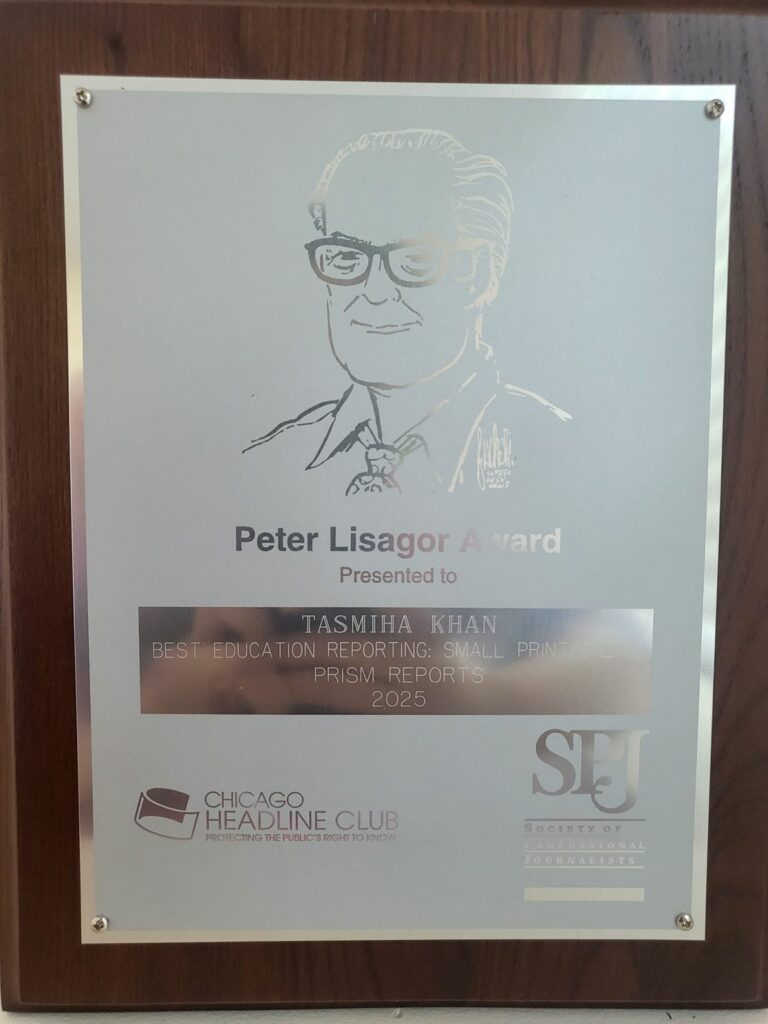
Right off the bat, you’ll notice that this profile of ASJA member Tasmiha Khan includes a picture of the prestigious journalism award she won, not of her.
That’s intentional. As a Muslim American Bengali woman, Khan prefers not to publicly display her own image. When she won the award, she opted to skip the in-person ceremony because she adheres to a religious conviction not to attend gatherings where alcohol is served.
The choices speak volumes about Khan’s determination to remain true to herself in her professional as well as her personal life.
Khan, a Chicago freelance writer covering religion, health, and social justice, has had her work published in such outlets as The New York Times, National Geographic, Forbes, VICE, Vox, The Daily Beast, Vanity Fair, Refinery29, Bustle, Ms. Magazine, The American Prospect, Zagat, and The Emancipator. She’s also provides strategic communications and content writing for mission-driven organizations.
She links her interwoven interests back to her undergraduate study of neuroscience and psychology at Wesleyan University, where she did her honors thesis on how Muslim Americans coped psychologically with the 10th anniversary of 9/11. Khan completed a year of medical school at the University of Utah before pivoting to earning a master’s degree in social impact from Claremont Lincoln University and doing research with the University of Chicago’s Initiative on Islam and Medicine. Later, she ran national health care campaigns for the MomsRising Education Fund.
“Along the way, I noticed the same gap appearing again and again: Systems fail people not for lack of solutions, but because nobody with power is listening to the people affected,” Khans said. “Storytelling lets me document that gap and, increasingly, show what’s working to close it.”
In an email interview, Khan talked about battling stereotypes, telling stories that change lives, and when marketing yourself as a writer, leading with value. The conversation has been lightly edited for length and clarity. Want more? Khan will talk about “owning our own narrative” at ASJA’s members-only monthly DEAI Chat on Nov. 11 at 11 a.m. Eastern time; get details and log onto the chat in the ASJA Member Center.
You’ve publicly shared about being mistaken as foreign because you observe hijab, and it’s led you to “champion the marginalized by debunking similar stereotypes.” How does your writing reflect that?
In my Emancipator reporting on incarcerated Muslim women, supported by the Columbia Journalism Lipman Center, I examined how prisons and jails fail them on basic health care and religious accommodation. The usual narrative treats Muslim women as either invisible or oppressed by their own communities. This story showed they’re often failed by the institutions that are supposed to protect them.
An Emancipator piece on Muslim women and their doctors did something similar. It showed that disparities in care often stem from providers who don’t listen or understand cultural context, not from patients being “difficult” or “noncompliant.”
I also took on assumptions about Muslim women’s lives more directly in a New York Times piece on gender-separate weddings. Outsiders tend to read gender separation as a sign of oppression, so I wrote about it from inside the community, as a norm many couples choose and cherish. I still remember how a source described herself as feeling like a princess, comfortable without having to worry about men’s gazes.
How much does representation matter in getting stories told that dispel stereotypes and broaden perspectives?
A lot, and it works on two levels. Practically, I know which questions to ask and which sources are being overlooked, so I don’t spend my first three interviews learning the basics. Editors get stories they would otherwise miss. On the human side, sources open up differently when they don’t have to explain themselves from scratch. But representation among writers isn’t enough on its own. Editors also have to be willing to commission stories that don’t fit familiar frames, and to trust that readers will follow.
When it comes to reporting on Muslim American women or Islamic cultures more broadly, what do you wish editors and writers did better?
Muslim women aren’t a monolith, and a hijab isn’t a thesis statement. Please don’t open every story with the headscarf or treat “Muslim voices” as one voice. Look beyond the same two or three sources. Include Black, South Asian, Somali, Arab, and convert Muslim women, who often have very different experiences. Frame us as people who live in systems like healthcare, schools, and prisons, not only as a lens on terrorism or oppression. Think about Ramadan before you set deadlines. Don’t ask one person to “represent” a whole faith in a quote.
You write for business clients and journalism outlets. How much of your work is content writing and copywriting?
It’s a mix, but right now I’m geared more towards content and copywriting. My earlier work was mostly freelance reporting. Over time, my business has moved from transactional writing toward strategic communications, content marketing, and copywriting. The investigative skills I use as a reporter, like asking sharp questions, structuring complex information, and finding the human story, transfer well to business writing.
What’s a recent project you’ve worked on?
A deputy alternate defender in California hired me to write a report for a case involving a young Muslim man, born into a post-9/11 world, who was facing a long time in custody. She wanted the judge and the defense attorney to understand something that doesn’t show up in a case file: what it does to a kid to grow up under permanent suspicion, and how that shapes his decision-making before he’s old enough to fully understand it himself.
She later told me the perspective I brought was crucial in the settlement discussions, because when the people in a courtroom come from different backgrounds, there’s no way to know how religion, culture, and racism have shaped the person whose life they’re deciding. My report, along with mitigation his family gathered, helped bring his sentence down to significantly less time than what had been on the table.
I got into this business to tell stories. I never expected the same skill to change how long someone stays in custody. I was nervous about carrying the weight of that, but I trusted myself, and I still think about what could have happened if I hadn’t.
You’ve founded a nonprofit organization. What’s was its mission?
I founded Brighter Dawns in 2010, and ran it until 2020, when the pandemic hit. It worked with communities in Bangladesh and the U.S. Over the years, we built 17 wells and 20 latrines that gave more than 20,000 people better access to clean water. Along the way, I worked with several other startup nonprofits, and I kept seeing the same problem. The organizations were doing meaningful work, but the evidence of it was scattered across spreadsheets, grant reports, financial records, and the memories of staff. Even strong programs were hard to explain, and donors and funders couldn’t always see what their support had made possible.
That pattern is what led my partner and me to start Inkpactful, which helps mission-driven organizations turn that scattered information into clear, compelling impact communications. We build annual reports, impact reports, newsletters, donor and funder communications, and case studies that put real stakeholder stories next to the data.
You wrote an ASJA Confidential article based on a 2026 ASJA conference session on letters of introduction. What LOI takeaways are you applying to your writing business?
My biggest takeaway was to stop being afraid and go for it. Too often writers wait to be asked. The session reminded me that being passive costs you opportunities. The other big lesson was to lead with value. If I see a problem or a gap, I say so and show where I could help, rather than just asking for work. Editors and stakeholders are much more likely to pay attention when you’ve already done some thinking for them.
When and why did you become an ASJA member?
I first joined ASJA in 2024, but my membership lapsed. I rejoined last year, largely because of ASJA President Darcy Lewis. We reconnected at the National Association of Science Writers conference, and she sat down with me one-on-one. That conversation was so helpful that it brought me back.
What’s the ASJA benefit you appreciate the most?
The network. I’m often asking other members for advice, and those conversations have been some of the most useful parts of my writing career. Sometimes the benefit is unexpected. I recently connected with (ASJA member) Megy Karydes, and we discovered we were both finalists for the Lisagor Awards. I had completely missed the news, and she was the one who told me. It was a wonderful surprise, and I ended up winning. It brightened my day, my week, and honestly my month. That kind of generosity is what I value most about the community.
**
Sonya Stinson is a New Orleans-based content marketing writer and journalist. She writes frequently about small businesses; innovators in science, technology and the arts; HR and education technology; and the meetings and tourism industry. She’s a member of ASJA’s DEAI and Publications committees. Connect with her on LinkedIn here.